



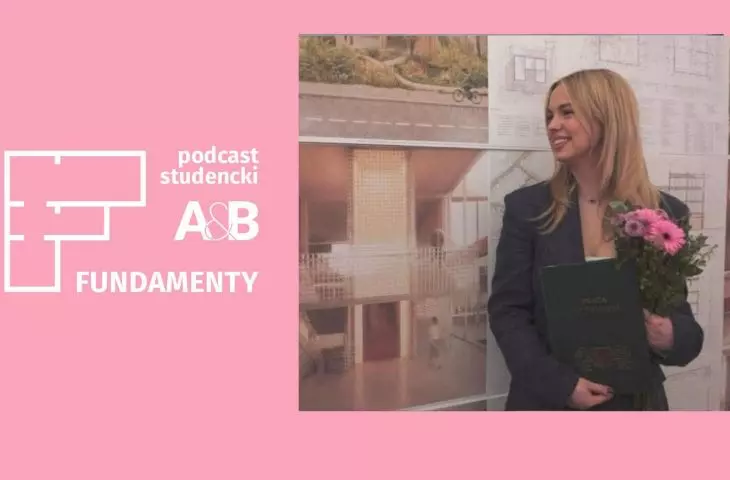

Zuzanna Rujna —“
” podcast #74 from the “Fundamenty” series
This episode and the entire series are also available on SoundCloud and Spotify:


Architecture studies require not only creativity, but also time, discipline, and preparation for dealing with technical issues. Zuzanna Rujna, a graduate of the Bachelor of Engineering in Architecture program at Gdańsk University of Technology and a current master’s student at the same university, talks about what to expect before starting this program. She discusses the admissions process, the drawing and math exams, the cost of studying, time management, and the experience she gained during her Erasmus exchange at the Politecnico di Milano.
Architecture Begins Before College
According to Zuzanna, it’s worth starting to prepare for architecture studies even before taking the high school graduation exam. The exam itself isn’t always enough, because for the architecture program, an important part of the admissions process is also an entrance exam that assesses drawing skills and aptitude for studying architecture. The format of this exam may vary, so it’s a good idea to check the current requirements of a specific university before you start preparing.
Zuzanna took the exam in 2022. At that time, one part of the exam involved drawing a still life on an easel, and an online test was held the following day. As she notes, the way the exam is conducted may change, so information from a few years ago won’t always match the current admissions rules.
She herself attended additional drawing classes for about two years. However, this does not mean that every applicant needs such a long period of preparation. A course can primarily help in mastering the basics—such as proportions, perspective, and composition—as well as in understanding the specifics of the exam.
Math Matters, Too
Although architecture is primarily associated with design and drawing, Zuzanna points out the technical nature of the program at a technical university. The curriculum includes, among other things, mathematics, mechanics, and other technical subjects.
Based on her own experience, she therefore recommends taking advanced-level math. In her opinion, students who have previously covered a broader range of material find it easier to adapt at the beginning of their studies. Of course, this doesn’t mean that you can’t study architecture without advanced math, but getting into the technical part of the program may be more challenging.
It is precisely this combination of different fields that is one of the defining features of this major. Design and creative work intersect with mathematics, mechanics, and descriptive geometry.
The program is time-consuming
One of the most important things Zuzanna would like to convey to those considering architecture is the realization that the program is very time-consuming. Before beginning her own studies, she searched the internet for other students’ opinions and came across stories about sleepless nights, a large number of projects, and intense work. Some of these stories were indeed confirmed by her own experience, but that doesn’t mean the program should discourage prospective students.
Classes at Gdańsk University of Technology can take place practically every day, especially in the first few years, sometimes lasting late into the evening. However, the end of classes doesn’t mean the end of work. A large portion of the projects continues at home, where students must prepare, among other things, drawings, models, visualizations, diagrams, and presentations. At certain points in the semester, assignments can pile up.
That’s why time management is such an important skill. Zuzanna emphasizes that while individual courses may present different challenges, good time management allows you to better cope with the demands of the program.
Is it possible to work at the same time?
One of the practical questions that arises when choosing a degree program is whether it’s possible to combine it with a job. Zuzanna believes that a regular part-time job can be difficult to balance with architecture. She knows people who worked on a freelance basis, on weekends, or after hours, but she herself would not have assumed before starting her studies that she could easily combine them with several dozen hours of work per week.
So if you need to work, it’s worth thinking through the financial aspects of your studies in advance. It’s possible to take advantage of various forms of academic aid or scholarships, but architecture itself generates additional costs. You’ll need a suitable laptop, as well as materials for models, prints, and other items related to project work.
From drawing to construction and visualization
At the same time, for Zuzanna, studying architecture is much more than just projects, printouts, and working on assignments. One of the greatest advantages of the program is its diversity. Students engage with both artistic disciplines—such as drawing, sculpture, and painting—and technical subjects—including mathematics, mechanics, and descriptive geometry. Thanks to this, over time, everyone can discover the area of architecture where they feel most at home.
One person might find their calling primarily in design, while another might excel in construction, visualization, urban planning, or the technical aspects of building design. According to Zuzanna, a degree in architecture doesn’t have to lead exclusively to a single career path. It can also open the door to design or more technical fields of work.
Erasmus in Milan
One of the most important experiences during Zuzanna’s studies was her Erasmus exchange at the Politecnico di Milano. She went on the exchange during her third year of studies. Her stay in Italy allowed her to see a completely different approach to teaching architecture. It wasn’t about judging which solution was better, but about learning two different ways of thinking about design.
At Gdańsk University of Technology, great emphasis is placed on the technical aspects of a project. Students learn about structures, systems, construction plans, and solutions that must be feasible. The starting point is also the specific conditions of a given plot of land, such as the local zoning plan.
In Milan, Zuzanna encountered an approach in which the idea itself was paramount in the initial stage. Students were encouraged to come up with interesting, sometimes even very bold concepts, and technical issues were addressed later. Under this approach, the focus at the beginning of the process was not on constraints such as the zoning plan or requirements for emergency exits.
The difference was also evident in how classes were organized. While in Poland a student might take a dozen or so different courses, in Milan Zuzanna had only a few, and attendance was not mandatory for some of them. This allowed her to devote more time to developing projects and ideas.
Designing the Future
One of the most interesting projects Zuzanna worked on in Milan was a vertiport—a facility related to future air transportation, designed for passenger flying vehicles, including drones.
The topic was completely new to her. The team first had to understand what such a facility might be, how it would function in the future, and what the associated transportation system might look like. Throughout the semester, the students developed a project based on a solution that does not yet exist in the real world. This experience showed Zuzanna the value of designing things that do not yet exist. It also allowed her to take a broader view of the role of imagination in the design process.
Two Complementary Approaches
Combining her experiences from Poland and Italy allowed Zuzanna to recognize the advantages of both educational approaches. Gdańsk University of Technology taught her to pay attention to details, focus on the technical aspects of a project, and translate an interesting vision into concrete, feasible solutions.
Milan, on the other hand, showed her that at the beginning of the design process, it’s sometimes worth setting limitations aside and allowing herself to explore bolder ideas. These two approaches don’t have to be mutually exclusive. On the contrary—they can complement each other.
For someone starting college, the most important thing is therefore to be well-prepared for the admissions process, but also to maintain the right perspective. Architecture requires a lot of work, and there are times when a project takes up almost all of your free time. At the same time, it offers the opportunity to explore many different fields, meet people with similar interests, go on an exchange program, and gradually develop your own way of looking at architecture.
After completing her bachelor’s degree, Zuzanna is continuing her studies at Gdańsk University of Technology and plans another Erasmus exchange. As she herself points out, the fact that she wants to continue developing in this direction is the best proof that, despite the demanding nature of her studies, she does not regret her choice.
Aleksandra Skorupa
Listen to other podcasts
from the “Fundamentals” series
66. Piotr Litwiński on the evolution of architecture and the functionalism of the future
67. Natalia Stateczna on her path to architecture, photography, and the power of good people
68. Internships in Denmark and Finland. Agata Jankowska on working in international architecture firms
69. The Life of a Young Architect: What Architecture School Teaches You
70. Justyna Dmytryk on her internship at Moke Architecten in Amsterdam
71. Petro Vladimirov on his internship at Henning Larsen
72. Martyna Lesisz on the realities of studying architecture